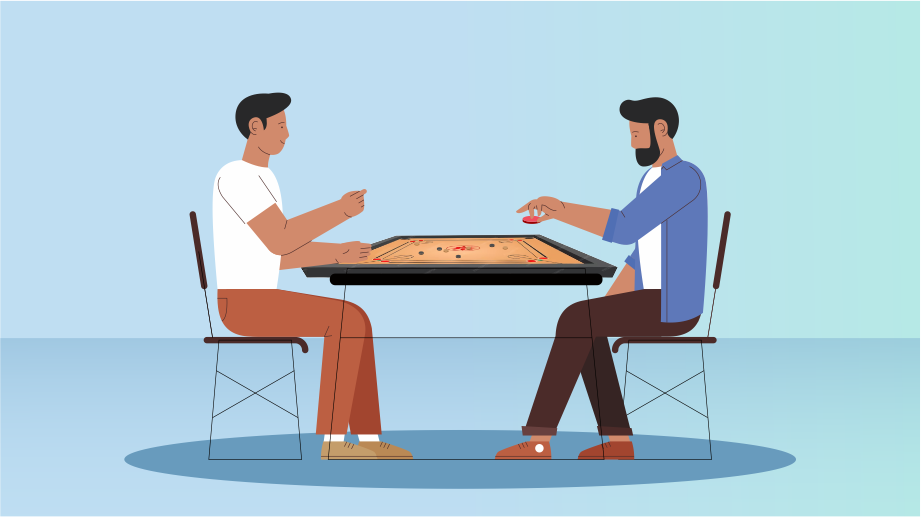
Carrom is a fascinating board game that originated in India. The game demands a combination of precision, strategy, and fine motor skills. Carrom’s magic has transcended borders, captivating the hearts and minds of enthusiasts in South Asian countries like Sri Lanka and Pakistan, and many more. India has a rich history associated with carrom and many Indian carrom players have performed exceedingly well in various international competitions.
Though carrom is more popular as a form of entertainment or pastime game, it offers many great benefits for our mental health. This unassuming game has the power to sharpen our analytical thinking skills, intensify our focus, and elevate our hand-eye coordination. It is also seen as a great tool for building social relationships and is a stress buster.
Despite its rich history and success, carrom in India confronts several challenges that could potentially impact its future. The younger generation’s ever-growing fondness for electronic games threatens to overshadow the charm of traditional tabletop games. Lack of international recognition is another reason that hinders the growth and popularity of carrom in local communities.
Do you have ideas to popularize Carrom or do you have the resources that can help carrom enthusiasts turn into professional gamers? Here’s your chance to voice your ideas and help push the game forward in your district!
Reference Sites – http://www.indiancarrom.co.in/
https://maharashtracarromassociation.com/
Food for thought
- The young generations are struggling with severe digital addiction. Can we promote carrom as a great activity to keep kids creatively engaged and reduce digital addiction?
- Can we work on elevating the status of Carrom from a casual pastime to a respected and professional game?
- Can we host local carrom tournaments or matches during community festivals to increase interest among people?
- The government has launched various programs and job opportunities (sports quota) for carrom players. Can we work on spreading the word about these opportunities to inspire younger generations to pick up the carrom?
- Can we utilize the power of social media platforms to attract more attention and increase participation from people?

In the land of diverse sports and unwavering passion, badminton has found its own special place in the hearts of millions. A sport that combines agility, precision, and electrifying rallies, Badminton has captured the imagination of millions. Impressively, India has been home to many Olympic medalist players including Prakash Padukone, Saina Nehwal and PV Sindhu.
Badminton is the ultimate workout for your body and mind. It’s a powerful tool that strengthens your bones and muscles while granting you the flexibility of a true athlete. The fast-paced rallies are perfect for cardiovascular health and weight management. This sport is more than just a game; it’s your path to wellness and vitality.
The Indian badminton team is dominating the global badminton scene in recent years, but there are still numerous challenges that need to be addressed. Especially, in rural areas and small towns, there is a lack of adequate infrastructure and coaching facilities, which is a significant hurdle for increasing its popularity among local communities.
Townsol is a passionate community and our members are committed to raising awareness about different sports within their districts. Let’s share our thoughts, ideas, and experiences on how we can collectively make badminton a way of life!
Reference Sites –
https://www.badmintonindia.org/
https://www.facebook.com/p/Maharashtra-Badminton-Association-100063905642300/
https://playbaddy.com/maharashtra-badminton-association/
Food for thought
- Can we work on developing or improving badminton facilities and infrastructure in our district? This could include indoor and outdoor courts, lighting, and seating arrangements.
- Can we facilitate easy access to affordable badminton equipment such as rackets, shuttles, nets, and appropriate sportswear to aspiring players in local stores?
- How about partnering with international sports clubs to give local talent access to international mentorship?
- Can we host local badminton tournaments and events to create excitement and competition within the community?
- Can we create dedicated local district level sports channels or news portal to build engagement and interest in the sport?

Swimming is a sport that requires a unique combination of strength, agility, and endurance to excel. As our nation proudly celebrates talents like Sejan Prakash and Srihari Natraj, who’ve earned their place on the global stage at the Olympics, we’re reminded of the incredible journey that India has embarked upon in making swimming as a popular sport.
Beyond the shimmering waters and podium finishes, swimming is not just a sport; it’s a life skill and a great form of exercise as well. Swimming works as a full-body workout and enhances body flexibility. It improves our cardiovascular health and also helps a lot in reducing stress and anxiety levels.
While swimming’s popularity is increasing as a fitness activity, it has faced challenges in establishing a prominent position in the Indian sports landscape. Not too many Indian cities have well-maintained swimming pools and coaching facilities. Moreover, in several conservative families, women and girls are still prohibited from participating in swimming as a sport due to concerns about swimming costumes.
At Townsol, we are committed to building conversations and working together to promote beneficial recreational activities like swimming in our districts. Today our swimmers are setting national records, with concerted efforts, it won’t be long before Indian swimmers are Olympic winners! We invite you all to share your ideas to make this happen.
References
http://www.msaaa.co.in/
State Federations Affiliated with Swimming Federation of India
Food for thought
- Can we reach out to local businesses, government agencies, and sports organizations for financial support to develop better infrastructure and swimming facilities in our districts?
- How about promoting swimming as an essential life skill and creating “free or affordable swimming lessons “for people of all ages, including children and adults?
- Can local designers, manufacturers and traders come together to develop culturally appropriate swimming costumes for greater participation from women or girls?
- Can we work on supporting budding talented swimmers who can represent the district or state in regional and national competitions?
- Are there any swimming or sports scholarships available or can we constitute them to develop a roadmap for every budding swimmer to reach their full potential?
- Can experts from the field of sports, physiotherapy, nutrition and mental health come together to develop a program that can help amateur swimmers achieve the next level?
Let’s share our ideas and experiences for making swimming a popular sport in our district. We can work together to promote this incredible sport in our districts.
What is Lorem Ipsum?
Lorem Ipsum is simply dummy text of the printing and typesetting industry. Lorem Ipsum has been the industry’s standard dummy text ever since the 1500s, when an unknown printer took a galley of type and scrambled it to make a type specimen book. It has survived not only five centuries, but also the leap into electronic typesetting, remaining essentially unchanged. It was popularised in the 1960s with the release of Letraset sheets containing Lorem Ipsum passages, and more recently with desktop publishing software like Aldus PageMaker including versions of Lorem Ipsum.
Why do we use it?
It is a long established fact that a reader will be distracted by the readable content of a page when looking at its layout. The point of using Lorem Ipsum is that it has a more-or-less normal distribution of letters, as opposed to using ‘Content here, content here’, making it look like readable English. Many desktop publishing packages and web page editors now use Lorem Ipsum as their default model text, and a search for ‘lorem ipsum’ will uncover many web sites still in their infancy. Various versions have evolved over the years, sometimes by accident, sometimes on purpose (injected humour and the like).
Where does it come from?
Contrary to popular belief, Lorem Ipsum is not simply random text. It has roots in a piece of classical Latin literature from 45 BC, making it over 2000 years old. Richard McClintock, a Latin professor at Hampden-Sydney College in Virginia, looked up one of the more obscure Latin words, consectetur, from a Lorem Ipsum passage, and going through the cites of the word in classical literature, discovered the undoubtable source. Lorem Ipsum comes from sections 1.10.32 and 1.10.33 of “de Finibus Bonorum et Malorum” (The Extremes of Good and Evil) by Cicero, written in 45 BC. This book is a treatise on the theory of ethics, very popular during the Renaissance. The first line of Lorem Ipsum, “Lorem ipsum dolor sit amet..”, comes from a line in section 1.10.32.
Let us first understand the strengths and weaknesses of our hometown district and then see how we can take advantage of strength for our growth and how can we improve on the weaknesses.
So let us create a list and group of all strengths and weaknesses and then create separate topic for each group to brainstorm all possibilities. Strengths will show us many more ways for prosperity and weaknesses will motivate us to convert them into strength.
Strengths are like tourist places, natural resources, local industries, local human skills, celebrities, achievers and so on
Weaknesses like scarcity of water, reachability to every village, education of opportunities, lack of talent pool and so on
So let us all work together to build our lovely district.
Please participate in the discussion of various topics on this matter and we can come up with comprehensive plan of development for townmate’s consideration.
We can discuss here and work together to make every school in our native district to be the Best School based on the thoughts shared by townmates on the topic of “Definition of Best School.”
Also, we can look into the various aspects of school performance below.
- How many students pass in every standard every year?
- What is average percentage of marks?
- How many students are active in any curricular activities like drama, dance etc.?
- How many students have participated in the competitive exams?
- How many students have achieved success in the competitive exams?
- How many students are engaged in any of the sports?
Once we know answers to all such performance criteria then we can collectively think of how to improve the performance in each area.
One of the options could be, should schoolteachers and/or students be rewarded for their performance? How can teachers and/or students from the village schools be rewarded?
Should we establish a system of recognition of all such performers everywhere in the district and if possible, beyond district. (Sometimes, recognition has more value than money.)
Let us build big number of high achievers in many professions and careers in our lovely hometown district so that we all can be proud of them and ourselves forever!